Do I Need a 200 Amp Service? (EV, heat pump)
Updated 2026-10-30
Not always. If your home has 100 amp service, adding an EV charger, heat pump or electric range may or may not push it past its limit — it depends on what already runs in the house. The EPA says that for EV charging “even 100-Amp service is often sufficient, depending on how much electricity your other appliances use,” while ENERGY STAR says an upgrade may be needed if your main breaker reads 65, 100 or 125 amps and the panel has very few or no empty slots. The answer for your house comes from a licensed electrician’s load calculation, and there are ways to add loads without going to 200 amps.
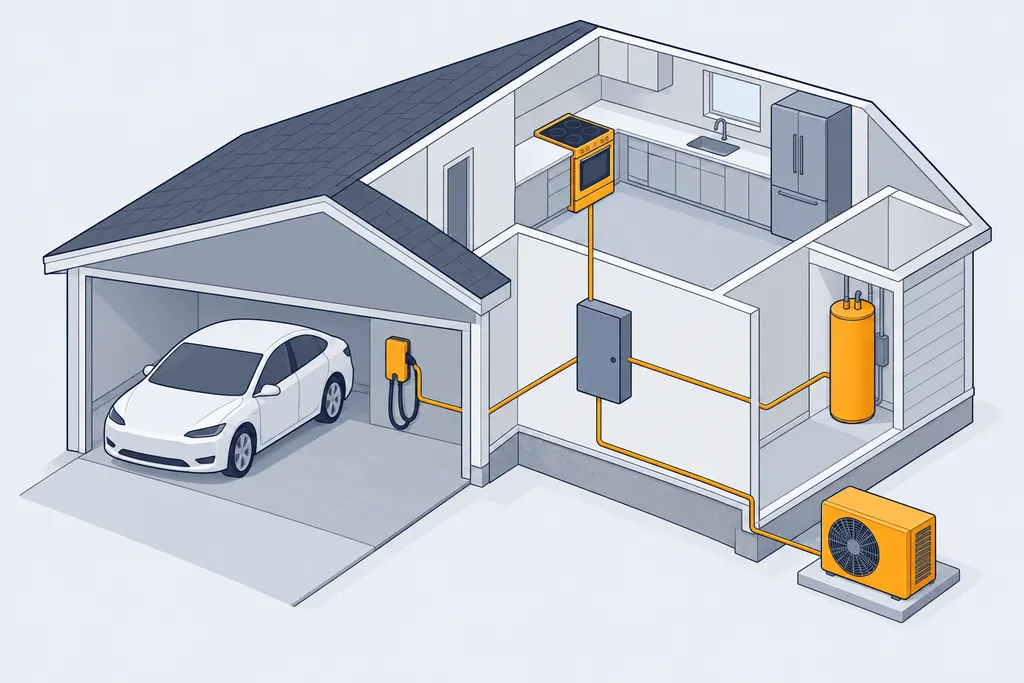
Quick answer by panel size
| What you see | What the sources say |
|---|---|
| Main breaker 65, 100 or 125 A, very few or no empty slots | Upgrade may be needed (ENERGY STAR) |
| Main breaker 200 or 225 A, several empty slots | Upgrade may not be needed (ENERGY STAR); the EPA says a home with at least 200 A and two empty slots for a double-pole breaker (the kind that runs larger appliances such as a dryer) likely has room for a Level 2 EV charger |
| 100 A and you want a Level 2 EV charger plus other electric appliances | Level 2 charging “is more likely to require demand-limiting technologies or panel upgrades” in a 100 A home (Berkeley Lab) |
How to find your amps: the EPA says you can often find your service size on the main switch of your main panel. A DOE-funded fact sheet also points to the amperage label on the utility’s meter box or on the panel. Anything behind the panel cover is a job for a licensed electrician.
Not every home has 200 amps. In an Electric Power Research Institute (EPRI) survey of 2,950 U.S. households, conducted August–October 2022 and shown in Berkeley Lab’s brief, 21% reported 100 amps or less, 9% reported 101–150 amps, 32% reported 151–200 amps and 2% more than 200 amps; 31% couldn’t find the main breaker and 5% saw no label. Because 36% couldn’t tell, these are shares of all answers, not of all homes. Berkeley Lab adds that older homes (especially built before 1960) and smaller homes (especially under 1,000 sq ft) are much more likely to have 100 amp panels.
Appliances that push a home past its current service
Typical sizes from Berkeley Lab’s 2024 brief, unless another source is named:
| Appliance | Breaker or draw | What the sources say |
|---|---|---|
| Level 2 EV charger (240 V) | Most draw 16–48 A on a 20–60 A breaker (Berkeley Lab) | A significant driver of service upgrades (Berkeley Lab); the EPA lists Level 2 chargers at 16–80 A, with 30–40 A more common |
| Level 1 EV charging (120 V) | About 1–2 kW | Minimal impact on infrastructure, but slower charging |
| Heat pump | 20–60 A breakers | Often doesn’t drive a service upgrade because it replaces the air conditioner; electric backup heat can change that |
| Electric range | 40–60 A breakers | May be harder to fit in a 100 A panel, depending on home size and other appliances |
| Tank water heater | 15–30 A breakers | Lower maximum draw; tankless electric models are far more likely to need panel changes |
| Electric dryer | 30 A breaker | — |
Running out of breaker spaces can also force a change. Berkeley Lab adds that very large homes, homes with more than one Level 2 charger, and homes with heated pools may need a bigger panel.
What an electrician’s load calculation shows
You can’t just add up the breaker numbers: a DOE-funded fact sheet notes that breakers will typically add up to more than the panel’s rating because appliances draw less than their breaker size and don’t all run at once. The National Electrical Code gives electricians several methods to size service, Berkeley Lab says: one sums the circuits after applying demand factors (allowances for the fact that not everything runs at once), and another is based on square footage, circuit counts and the nameplate ratings of large appliances.
The code also allows the electrician to use metered data — your home’s peak demand in 15-minute intervals from a smart meter — to decide whether new loads need a bigger main breaker. Berkeley Lab calls this “a much more accurate alternative” that can show an upgrade isn’t needed or can be smaller. The DOE-funded fact sheet describes the same idea using your utility records to find your maximum demand over a year. Ask your utility whether that data is available for your account. The DOE-funded fact sheet says electricians recommend that the load never exceed 80 percent of the service capacity.
Alternatives to a full upgrade
Ask your electrician about:
- Circuit sharing: one breaker serves two big loads, such as a dryer and an EV charger, letting only one run at a time (Berkeley Lab). ENERGY STAR puts these devices at around $500.
- Smaller or 120 V appliances: a lower-amp charger — the EPA says a 16-amp Level 2 charger may be enough if your panel is tight — or 120 V heat pumps, water heaters and dryers (Berkeley Lab). Level 1 charging uses a standard outlet but adds only about 3–5 miles of range per hour, and ENERGY STAR recommends it only for plug-in hybrids.
- Load management: systems that watch total load and shut off certain loads above a set limit. Berkeley Lab says their use for this purpose is enabled by the 2023 National Electrical Code; the EPA mentions load management systems that balance power between the charger and other appliances.
- Smart panel: can pause EV charging when other appliances need power; ENERGY STAR puts them at about $2,500–$4,000.
- Subpanel: if you’re short on breaker spaces but not on capacity, a subpanel can add spaces without a full upgrade (Berkeley Lab).
- Panel optimization: ENERGY STAR suggests asking your electrician about combining underused circuits where appropriate.
These are all jobs for a licensed electrician with a permit where one is required.
What upgrading the service involves
If the calculation says you need more capacity, going from 100 to 200 amps costs $1,300–$3,000 for most homeowners according to This Old House, and $1,800–$4,500 according to Fixr. ENERGY STAR warns that if the utility’s lines to the house must be upgraded too, that can cost $2,000–$30,000 and take a lot of time. Berkeley Lab notes that when the main breaker grows, the meter socket will likely need an upgrade too, and the utility is usually involved. If you do upgrade, the EPA suggests planning for future needs, such as charging more than one EV or switching gas appliances to electric ones like a heat pump. See 200 Amp Panel Upgrade Cost and Electrical Panel Upgrade Permits.
Next step: check your panel and talk to an electrician
Write down the amps on the main breaker, how many empty slots you see, and what you plan to add. Our Panel Risk Check also asks about the brand and warning signs, because an old panel that inspectors flag changes the decision.
If the panel feels warm or buzzes, have a licensed electrician look at it soon. If you smell burning, see smoke, or the panel is hot to the touch, leave the area and call 911.
FAQ
Can I do the load calculation myself? Online calculators give a rough estimate only, This Old House says; a licensed electrician does the detailed calculation.
Illustrations on this page are AI-generated to help you picture the situation. They are not photos of real homes, jobs or people.
Sources
- Berkeley Lab — Sizing Electric Service Panels and Utility Infrastructure for Residential Electrification (technical brief, July 2024)
- U.S. EPA — Getting Started with Home EV Charging (updated May 7, 2026)
- ENERGY STAR — Make Your Home Electric Ready (U.S. EPA, page undated; checked Oct 30, 2026)
- New Buildings Institute for the U.S. DOE Building Technologies Office — Home Electrification and Electric Panel Upgrades (fact sheet, posted Oct 2024)
- This Old House — What Is the Cost to Upgrade an Electrical Panel? (updated Mar 31, 2026)
- Fixr — Electrical Panel Upgrade Cost (updated Jan 31, 2025)