GFCI Outlet Keeps Tripping
Updated 2026-10-30
A GFCI outlet trips when it senses electricity leaking where it shouldn’t — the U.S. Consumer Product Safety Commission (CPSC) says it cuts power when the current going out and coming back differ by as little as 0.006 amps. Leviton, a GFCI maker, says that leak is often caused by moisture, damaged wiring or a faulty appliance. Because one GFCI outlet can also protect other outlets further along the circuit, the cause may be plugged in somewhere else. If it keeps tripping with no clear explanation, or won’t reset, Leviton’s advice is to call a licensed electrician.
What a GFCI does and where you’ll find one
A ground fault circuit interrupter (GFCI or GFI) is there to protect people from severe or fatal shocks. The CPSC says it shuts off power faster than the blink of an eye — before the electricity can affect your heartbeat. A GFCI outlet protects whatever is plugged into it and other outlets “downstream” on the same circuit, so a dead outlet in one room can be tied to a tripped GFCI in another. GFCI protection can also be built into a breaker in the panel.
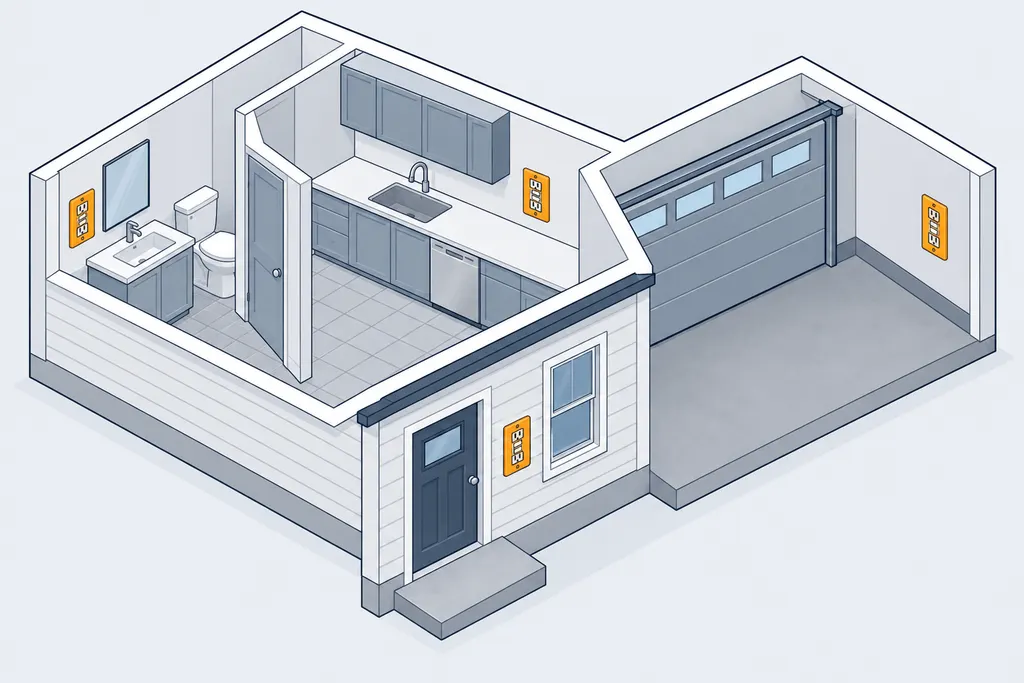
The National Electrical Code has added GFCI requirements over the years, according to the CPSC: outdoor outlets since 1973, bathrooms since 1975, garages since 1978, kitchens since 1987, crawl spaces and unfinished basements since 1990, wet bar sinks since 1993, and laundry and utility sinks since 2005. The code applies mainly to new construction and major renovations, so an older home may have fewer.
Causes of repeated tripping
- Moisture. Leviton names water exposure as a cause. For outdoor outlets, an article in the electrical inspectors’ magazine IAEI notes that water entering the receptacle can cause unintended tripping.
- A faulty appliance or damaged cord. The CPSC says ground faults happen most often when equipment is damaged or defective. IAEI notes that a trip caused by leakage from a damaged cord or decoration may be warranted — the GFCI is doing its job.
- Something on a downstream outlet. Leviton suggests checking devices plugged into outlets downstream of the GFCI, not just the GFCI itself.
- A wiring problem. Leviton says persistent tripping can point to moisture in the wiring, a damaged circuit or other hidden hazards.
- A worn or defective GFCI. Leviton lists normal wear and tear on the outlet among common causes, and says a GFCI that trips again right away may point to a wiring problem or a defective device.
What you can safely check before you call
These are look-and-unplug steps only. Don’t open the outlet or the panel.
- Look at the outlet and at everything plugged into it and into the outlets it protects. Leviton suggests looking for frayed cords, cracked cases or signs of overheating.
- Unplug anything that seems to cause the trip. Leviton says to unplug it right away, since it may be faulty or unsafe to use.
- Press Reset once and watch. Leviton says that if it trips again immediately, that suggests a wiring problem or a defective device; if it trips later under similar conditions, those conditions likely point to the cause.
- Write down which outlet tripped, what was plugged in, whether it was raining or something was wet, and whether it trips right away or later. That saves the electrician time.
If the breaker in the panel trips as well, see Why Does My Breaker Keep Tripping?
When tripping signals a real hazard
Call a licensed electrician if:
- the GFCI won’t reset, or keeps tripping without a clear reason (Leviton);
- the outlet is discolored, loose, damaged or warm — Leviton says those signs mean the GFCI needs immediate replacement;
- you got a shock, even a mild tingle — the CPSC calls any shock a possible warning of danger;
- the monthly test fails (see below).
If an outlet or switch feels warm or buzzes, have a licensed electrician look at it soon. If you smell burning, see smoke, or the outlet or switch is hot to the touch, leave the area and call 911.
This site doesn’t give instructions for electrical work. Replacing a GFCI or repairing the wiring behind it is a job for a licensed electrician.
Test it once a month
The CPSC says to test every GFCI at least once a month, after a power failure and according to the manufacturer’s instructions; ESFI adds after every major electrical storm. The CPSC notes that blackouts and other power disturbances can sometimes damage a GFCI’s ability to function properly, and ESFI warns that a GFCI can keep supplying power without showing that it no longer protects you.
The CPSC’s test uses only the buttons: with a lamp plugged in and on, press Test — the light should go out — then press Reset — it should come back on. If the light doesn’t go out, the CPSC says the GFCI isn’t working or wasn’t installed correctly — contact a qualified electrician. If it doesn’t come back on, the GFCI needs replacing, which is a job for a licensed electrician.
What an electrician will check
ESFI’s list for a home electrical inspection includes checking that required GFCIs are present and testing each one, checking the wiring of outlets, switches and fixtures, and verifying polarity and grounding at the outlets. Bring your notes on when and how it trips. For GFCI breakers in older panels, see Challenger Panels and Recalled Breakers.
Repair scope and cost factors
| Item | Figure | Source |
|---|---|---|
| Adding a GFCI or AFCI | about $130–$300 per device | This Old House, cost data from Angi contractor estimates (2026) |
| Upgrading to AFCI or GFCI breakers during a panel upgrade | can add $35–$60 per breaker | This Old House panel cost guide (2026) |
| Electrician labor | $40–$120 per hour | Fixr (2025) |
The two This Old House figures cover different situations, and neither says exactly what is included, so ask for a written quote that lists the device, labor and any wiring repair separately. If the electrician finds a wiring fault or moisture in a box, the price depends on that repair. More on rates: How Much Does an Electrician Cost per Hour?
FAQ
Is it safe to keep resetting it? Press Reset once and watch what happens. If it keeps tripping without a clear reason, Leviton’s advice is to call a licensed electrician.
Why did an outlet in another room go dead? It may be downstream of a GFCI that tripped. The CPSC says a GFCI outlet also protects outlets further along the same circuit.
Illustrations on this page are AI-generated to help you picture the situation. They are not photos of real homes, jobs or people.
Sources
- U.S. CPSC — What Is a GFCI? Fact Sheet, Publication 099 (Sept 2010)
- U.S. CPSC — Guide to Home Wiring Hazards, Publication 518 (undated)
- Electrical Safety Foundation International (ESFI) — Indoor Electrical Safety Check (2004)
- Leviton — What To Do When Your GFCI Trips: A Homeowner's Guide (undated, read Oct 30, 2026)
- IAEI Magazine — Holiday Lighting & Outside Electrical Receptacles (Nov 6, 2020)
- This Old House — How Fuses and Circuit Breakers Work (updated May 26, 2026)
- This Old House — What Is the Cost to Upgrade an Electrical Panel? (updated Mar 31, 2026)
- Fixr — Electrical Panel Upgrade Cost (updated Jan 31, 2025)